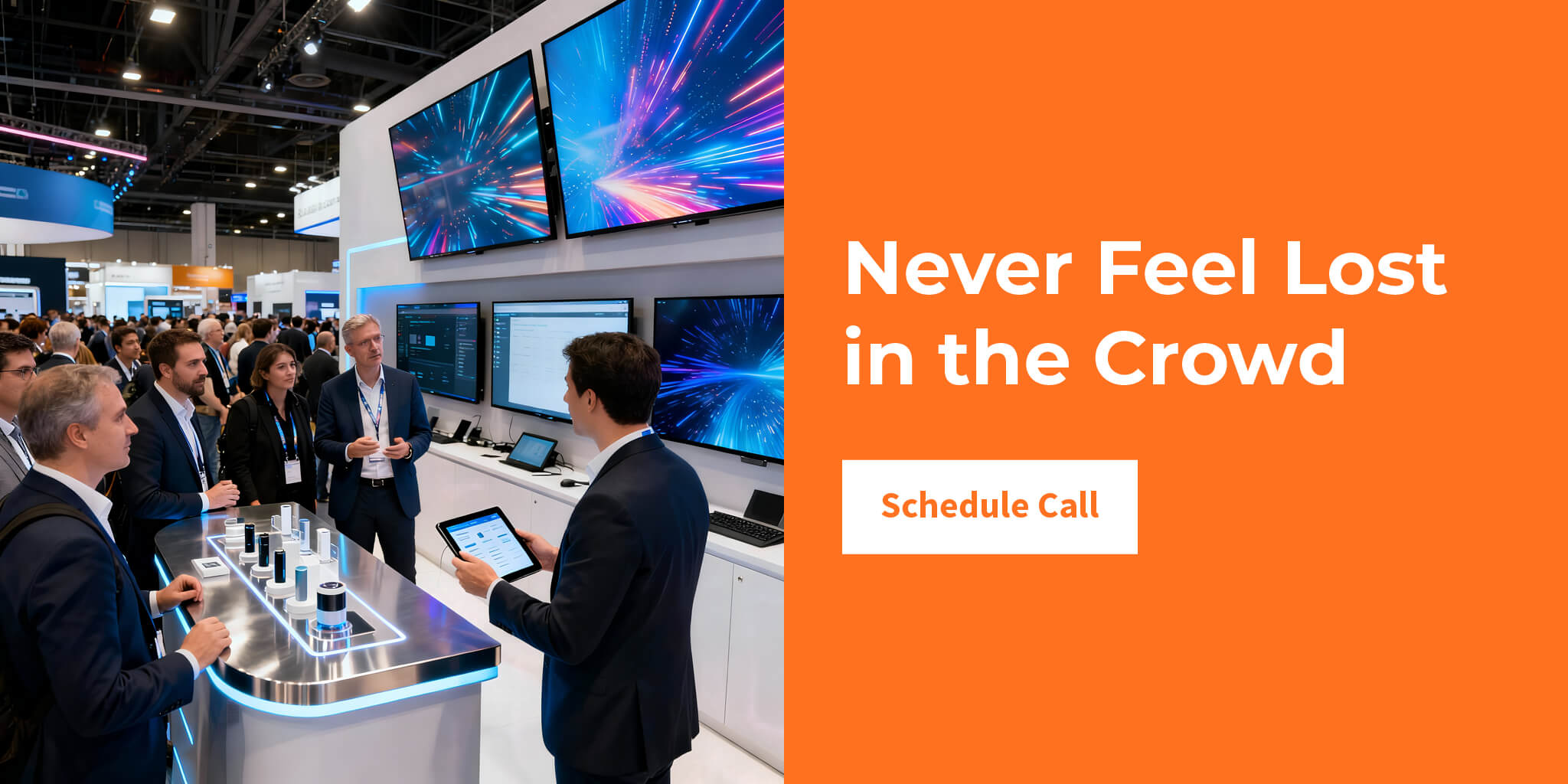


It’s January. And the annual industry trade show is just around the corner. If you have a booth, then it’s time to choose who will be staffing the exhibit this year. If you’re like most companies, you’re sending the sales team with a token marketing representative and a C-level executive or two. There’s nothing obviously wrong with that decision. After all, the sales team knows how to prospect, qualify, and close sales.
Take a moment to consider your past trade shows. Have you been overjoyed by your results? Has your return on investment been less than stellar? Perhaps it’s time to reconsider how you plan, prepare, and approach sales at trade shows. Are trade shows, in fact, a special selling environment requiring targeting strategies to attract, engage, and convert attendees into potential customers.
In this article, we’ll explore the unique qualities of trade shows and how they may require not only a specific sales approach but also a trained staff of sales, marketing, customer service, technical, and senior management professionals.
Understand Your Trade Show Goals Before You Sell
The saying, “Know before you go” may seem like obvious advice, but if you were to ask most exhibitors to share their goals, the vast majority would say, “Increase sales and collect as many leads as possible.” While those are “goals,” they’re not a strategy. And goals without a strategy is a recipe for failure at any trade show or event.
Let’s start with identifying some basic goals. These can be typically grouped into four categories:
- Lead Generation – Capturing new business
- Brand Awareness – Increasing visibility in the industry
- Relationship Management – Retaining existing clients
- Direct Sales – Selling products and services on the show floor
OK, you’ve identified a big picture goal(s). Next, how do you achieve them and what measurements are you using to determine your success? Not all measurements have to be quantitative. Some companies set both ROI and ROO (Return on Objectives) goals. ROO goals can be more challenging to measure. For example, let’s say an objective is to position your company as a “thought leader.” Measurements could include mentions in social media about your booth presentations or demos. Or the number of surveys completed by visitors who recall your top three propositions.
Finally, trade show goals and strategies are the foundation for any successful show. Now it’s time for the rubber to meet the road. Or the feet to meet the flooring. Your team has to perform, which starts well before the trade show starts. Ideally, they should have had input on the goals and strategies. Strong trade show teams understand what’s expected of them and their roles, In addition, they understand the roles of everyone else. Effective team leaders review the goals before each day and then gather everyone at the end of the day to hear what worked and what didn’t… and then make any adjustments for the next day.
Choose the Right Trade Show for Your Business
You have a marketing budget and it’s not open-ended (if only). Choosing the right trade shows can be a challenge, especially if you have a busy trade show schedule. Every industry has several “must attend” shows, like AHR Expo for plumbing trade, but your company may have products and services for a variety of industries. In that case, you will have to decide which trade shows to attend and your financial commitment for each one.
To maximize your Return on Investment (ROI), evaluate potential shows through these four lenses:
- Audience Alignment. The number of attendees is a vanity metric; the quality of attendees is what drives revenue.
- Vertical vs. Horizontal: A “vertical” show focuses on a specific industry (e.g., Biotech), while a “horizontal” show focuses on a job function (e.g., Marketing or HR) across many industries.
- Buying Power: Check the prospectus for the percentage of attendees with “final decision-making authority.” You want to talk to buyers, not just browsers.
- The Competitor Check: If your biggest competitors are there, you likely should be too. However, if the floor is overcrowded with companies exactly like yours, look for a “niche” show where you can stand out as the primary solution.
- Logistics and Timing. Success is often a matter of geography and the calendar.
- Location Strategy: Is the show in a hub for your industry? For example, a manufacturing show in the Midwest or a tech show in the Pacific Northwest often draws a stronger local crowd of practitioners.
- The Sales Cycle: Align the show date with your product launches. If you sell seasonal goods, exhibiting a month after retailers have finished their buying season is a missed opportunity.
- Floor Dynamics. Evaluate how the show handles the “experience” of exhibiting.
- Traffic Drivers: Does the show organizer use tech like AR scavenger hunts, gamification, or interactive kiosks to move people into the aisles?
- Lead Retrieval: Review how the show handles data. If their lead-retrieval system is antiquated, it will slow down your follow-up process.
- Modular Flexibility: Consider if the show floor layout supports modern exhibit designs (like LED video walls or modular Gravitee/Symphony systems) or if you’ll be restricted by rigid piping and drape rules.
- Calculating the Total Cost. The booth space is only about 30% of your total spend. Before committing, factor in:
- Shipping and Drayage: The cost of moving your materials from the loading dock to your space.
- Services and Labor: The cost of assembly and any turnkey services provided by the exhibit house.
- Marketing Integration: Budget for pre-show emails, social media teasers, and post-show follow-up campaigns.
Finally, obtaining details from the show organizer about previous attendance and exhibitors can sometimes be challenging. They can be very guarded about what they consider to be proprietary information. That said… Before signing a contract, ask the show organizer for a “Verified Attendee List” from the previous year. If they can’t provide a breakdown of industries and job titles, they may be hiding low-quality traffic.
Design a Booth That Attracts the Right People
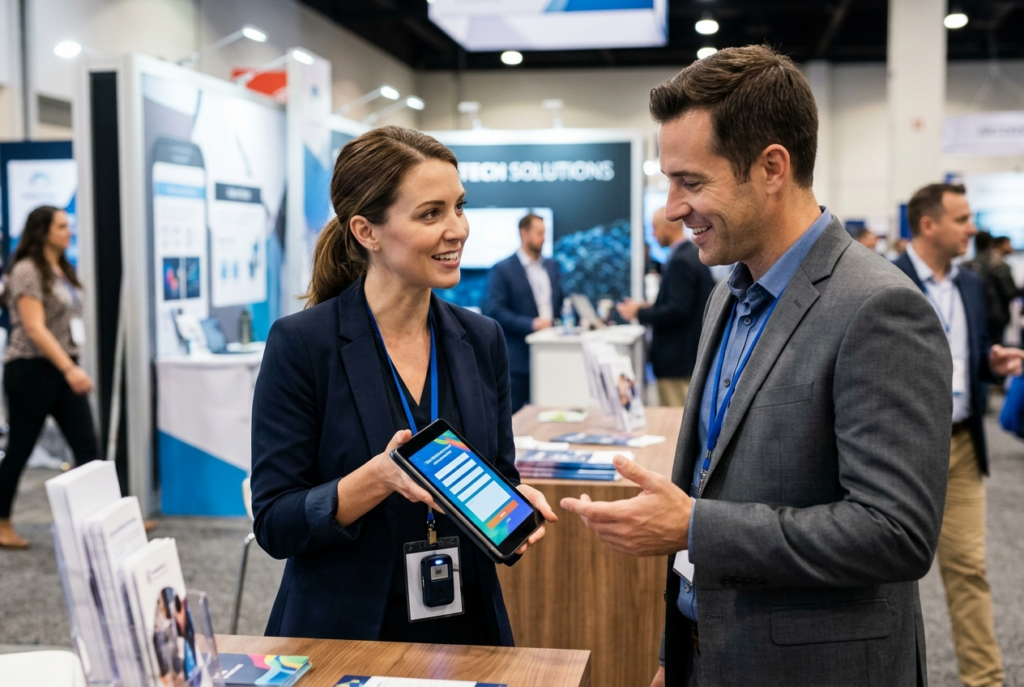
You already know a creative, well-designed booth can attract attention on the trade show floor. It’s the spotlight, the main stage, the front page of your trade show strategy. Designing a booth that attracts the right people is both easier and harder than you may think. There’s the basics:
- Focus on benefits, not just features
- Spark curiosity so attendees want to learn more
- Layer your messaging so it gets seen from a distance and in the booth
- Avoid clutter and barriers
- Create logical pathways for visitors to explore and your team to interact with potential clients
- Make it an experience. One that aligns with your branding and messaging.
- Know your audience. And focus relentlessly on that audience.
The simple basics matter. But you know what matters more? Working with exhibit design professionals who spend every day creating exhibits that attract people. Trust them, but before you do, spend time understanding the process. These four articles are excellent summaries of how to approach exhibition design.
- 10×10 Trade Show Booth: Compact Design, Big Impact
- Modular Trade Show Booth Design: Flexible, Scalable, and Smart
- Creative Trade Show Booth Design Tips to Give You an Edge
- Exhibition Design Essentials: Tips, Strategies, & More
Train Your Team to Sell, Not Just Stand
Booth staff training is an important competitive advantage. Yet, most companies ignore it or simply go through the motions. It’s not automatic. The same energy that went into designing the exhibit, creating the graphics, completing the forms, and arranging the travel and lodging should go into training.
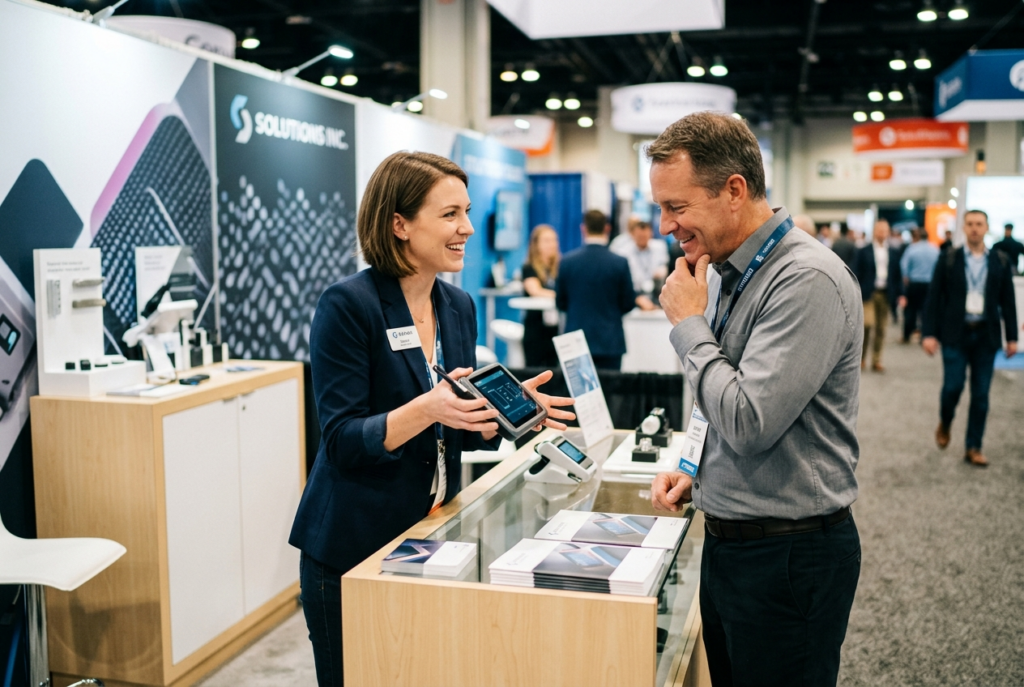
Who should be there? That’s easy. Bring employees who know the products or services, who have charismatic people skills, who are personally invested in results, and who participate in pre-show planning or post-show implementation. Two out of four doesn’t cut it. A trade show isn’t a vacation. It’s a strategic investment. Your sales team may check all those boxes, but don’t be afraid to look for superstars in other departments who want to be at the show, understand the products and services, and will WOW! attendees.
Booth Staffing Rules
Staffing is only as complicated as you make it. Let your trade show objectives guide you when making decisions on who to bring and how to achieve those objectives.
Rule #1: Knowledge
Not every booth staffer needs to know everything. Collectively, however, the team needs to know everything and know who’s the expert about every subject. The expert should be able to answer questions about that topic, as well as explain the features and benefits of your products or services.
Rule #2: Goals
Set clear goals for your booth staff. What do you hope to achieve by participating in the trade show? Then provide your staff with training on your products or services. This should include a thorough overview of your offerings, as well as any recent updates or changes.
Rule #3: It’s Not Over Until It’s Over
Provide your staff with feedback throughout the training process. This will help them to identify areas where they need improvement and make sure that they are on track to achieve their goals. Pre- and post-show staff meetings keep the team focused on the goals and address any concerns.
Rule #4: Explore
It’s not just about what’s happening in the booth. Give them time to explore the show floor, check out competitors, discover new suppliers, and meet with attendees at social events.
Rule #5: Have Fun!
Attending a trade show should be fun, and trade show booth staff training should be a positive experience for everyone involved. Make sure to create a relaxed atmosphere where your staff can learn and grow.
Use Smart Lead Capture Strategies
Smart lead capture strategies transform a booth from a simple “meet-and-greet” station into a sophisticated data engine. Moving beyond the traditional bowl of business cards allows a team to act on information while the “show floor energy” is still high.
Here are the primary benefits of implementing a smart lead capture strategy:
- Instant Data Qualification. In a busy environment, not every visitor is a high-priority prospect. Smart systems allow staffers to “tag” or “grade” leads (e.g., Hot, Warm, Cold) immediately after a conversation.
- Accelerated Follow-Up Velocity. The “half-life” of a trade show lead is incredibly short. A smart strategy bridges the gap between the event and the first sales call.
- Frictionless Attendee Experience. Modern lead capture focuses on “passive” or “low-friction” interactions that respect the attendee’s time.
- Enhanced Engagement through Gamification. Smart capture doesn’t have to feel like an interview; it can be part of the booth experience.
- Measurable ROI and Analytics. Without digital capture, “success” is often based on a gut feeling. Smart strategies provide hard data to justify the exhibit spend.
- Sustainability and Cost Reduction. Reducing the reliance on printed materials has both financial and environmental benefits.
By treating lead capture as a strategic tech integration rather than a clerical task, you ensure that the momentum generated on the show floor is successfully converted into measurable business growth.
Use Giveaways the Right Way (Not Just Free Stuff)
Whether you use the term premium incentives, promotional products, or trade show giveaways, the goal should be the same. You want to capture the attention of potential clients AND be remembered for all the right reasons.
So, what are the right reasons? Everyone loves a freebie, and giveaways are a proven method for attracting people at a show. However, “If you think of them as trade show giveaways,” according to Rama Beerfas, owner of Lev Promotions, “They will have as much value to your recipients as they do to you. If you reframe them as promotional incentives or gifts, you’ll start to realize that a target branded incentive can bring you closer to achieving your goals and providing measurable results.”The Primary Goals of Promotional Incentives:
- Drive Sales and Revenue: By offering discounts, free gifts, or other perks, businesses can encourage immediate purchases.
- Improve Customer Loyalty and Retention: Loyalty programs, rewards, and exclusive offers make customers feel valued, strengthening their bond with the brand and encouraging repeat business.
- Customer Acquisition: Incentives can attract new customers to a business, expanding the client base.
- Generate Demand: Creating interest in products or services to stimulate purchases.
- Increase Brand Engagement: Encouraging customers to interact more deeply with the brand.
- Collect Customer Data: Offering incentives in exchange for data like email addresses, preferences, or feedback.
Follow Up Quickly After the Trade Show
The true value of a trade show is rarely realized on the exhibit floor. During the event, interactions are often fast-paced and competing with dozens of other distractions, leaving even the most engaged prospects with only a hazy memory of your brand. Following up serves as the critical “second touch” that reinforces your value proposition, moving the relationship from a fleeting introduction to a concrete business lead before the “show floor amnesia” sets in.
Speed is the primary differentiator.. Research consistently shows that the first company to follow up after a convention has a significantly higher conversion rate, as promptness signals professional reliability and organizational health. By reaching out within 48 to 72 hours, you capitalize on the “momentum of interest”—the window of time where the prospect is still actively thinking about the problems they came to the show to solve and is most receptive to a tailored solution.
Finally, immediate contact provides an opportunity to transition from a general pitch to a specific consultation, addressing the unique pain points identified during the initial meeting. Whether it’s sending a requested white paper, scheduling a deep-dive demo, or simply thanking them for their time, a strategic follow-up process ensures that your significant investment in booth space and travel yields a measurable, long-term return on investment.
How Exhibits Northwest Helps You Sell More at Trade Shows
Our experienced team at Exhibits Northwest knows the ins and outs of how to prepare for a trade show. We can help you develop an immersive, engaging trade show program whether you purchase or rent your exhibit.
We start by having a conversation that will help us begin to understand your goals and brand identity. Next, we design and build an exhibit that meets your needs and budget. Lastly, we partner with your team to plan and execute each and every trade show on your schedule to ensure your next trade show will always be your best trade show.
Conclusion
With over twenty years of experience designing, building, shipping, and storing trade show displays, the ENW team can assist you with the nuances and complexity of trade show marketing. And if you want your new exhibit to impress trade show attendees and draw crowds to your booth, then we’ve got that covered too. Schedule a call today.