


Not so many years ago, trade show exhibit lighting was both complicated and expensive. Not anymore. LED lights have transformed exhibits into illuminated beacons on the show floor. Backlit fabric graphics are now common, not only on larger island exhibits, but also on inlines and even table top displays. In addition, there are LED accent lights on counters, programmable lights with RGB colors, and even faux neon lights.
It’s no secret that lighting attracts attention on the trade show floor. The trick is to incorporate lighting strategically to elevate your branding while enhancing your messaging. For over 30 years, the Exhibits Northwest team has been working with clients in the Pacific Northwest. They have the experience to blend creative exhibit design with innovative lighting for a booth that shines brightly at any trade show or event. The first step is to schedule an intake meeting so they can understand your marketing and exhibition goals.
Why Lighting Matters in Trade Show Booth Design
Lighting has always been an essential tool to attract attendees on the trade show floor. LED lights have made that both easier and more challenging as exhibit designers incorporate lights into booth design in innovative ways. Fortunately, LED lights are endlessly adaptive in their ability to transform a static booth into an immersive brand experience.
- Capturing Attention in a Visual Ocean: Trade show floors are intentionally designed to be over-stimulating. Without strategic lighting, even the best-designed booth can look flat or recede into the background.
- High-intensity LED spotlights or backlit graphics act as a beacon, cutting through the visual noise and drawing the eye from across the hall.
- Studies suggest that well-lit booths can increase visitor interest by up to 40% compared to poorly lit competitors.
- Guiding the Visitor: Lighting serves as a non-verbal map for your visitors. It tells them where to look and where to walk.
- Accent lighting illuminates key products or key brand messages, ensuring they are the first things an attendee notices.
- Different lighting intensities can define “neighborhoods” within your booth—for example, bright, high-energy light for product demos and softer, warmer light for private meeting areas or lounges.
- Enhancing Products: When showcasing physical goods—from jewelry to heavy machinery—the quality of light determines how those products are perceived.
- High-Core Rendering Index lighting ensures that the colors of products appear vibrant and accurate. Poor lighting can make high-end materials look cheap.
- The strategic placement of fill lights prevents harsh shadows that can obscure product details or make your booth look tired and unapproachable.
- Practicality & Sustainability: Modern trade show LED lighting offers several logistical advantages
- Unlike incandescent and halogen bulbs, LEDs emit very little heat. This keeps your booth comfortable for staff and prevents graphics from warping or peeling.
- LEDs consume less power, which can significantly reduce the “electrical tap” fees charged by convention centers.
- LEDs are durable, adaptable, and sustainable. Not only is it rare for an LED light to fail during a trade show, but it’s also unusual for them to fail during an entire trade show season.
5 Types of Trade Show Exhibit Lighting to Consider
Overhead Lighting
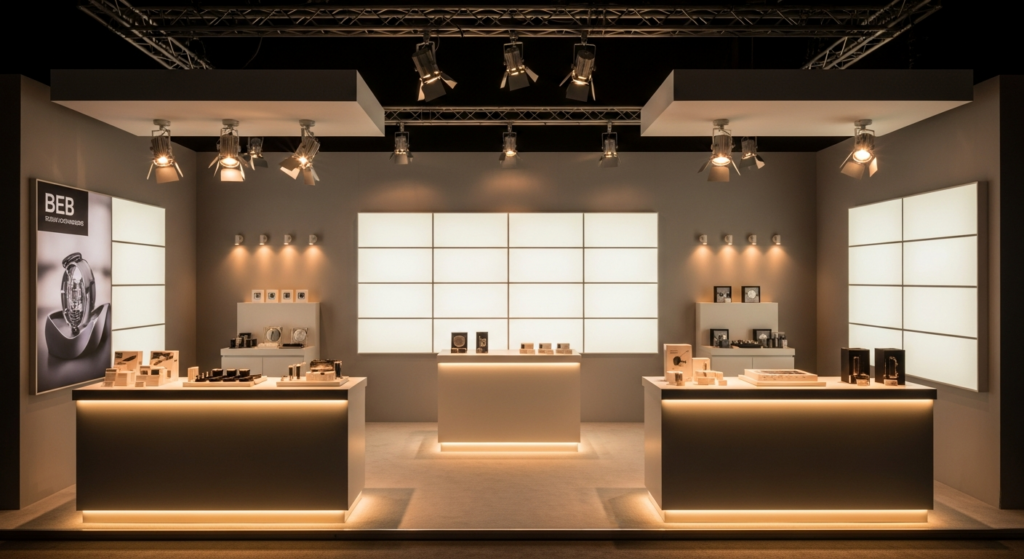
Every convention hall has overhead lighting. These are usually high-intensity lights, which can create shadows in your booth. Overhead lights in the booth space eliminate the “cave effect” by filling-in the shadows and making the booth space feel larger.
Overhead lighting includes spots from the convention hall ceiling, truss lighting, canopy spot lighting, and hanging signs with lights. A brightly lit ceiling of light defines your space and makes it feel like a high-end retail environment rather than a temporary display.
Custom LED Lighting
Programmable RGB and dynamic lights are ideal for changing the booth’s color instantaneously or via a pre-programmed sequence. With programmable RGB lights, you can match your brand’s exact Pantone color. Or use fading or flashing color sequences to catch an attendee’s attention.
Spotlights and Accent Lights
While overhead lighting provides basic visibility, spotlights act as “visual highlighters,” guiding attendees’ eyes to your most important assets.
An LED arm light is a versatile choice for exhibitors using metal frame or lightweight portable displays. It provides a natural white light that highlights the true colors of graphics and products. The swiveling head and strong grip make it easy to adjust as the booth layout changes.
Backlit Panels and Lightboxes
Backlit graphics and lightboxes are among the most effective ways to make a trade show exhibit stand out. These systems create vibrant colors and high-contrast visuals that are much easier to see from a distance than standard front-lit displays.
Backlit graphics provide superior visibility, a modern appearance, and convenient portability. Most LED lightboxes use silicone edge fabric graphics (SEG) and lightweight aluminum frames, which are both easy to assemble and ship.
Edge-Lit and Under-Counter Lighting
Edge-lit and under-counter lighting are sophisticated “finishing touches” that transition a trade show booth from a basic display to a premium, high-tech environment. While overhead lights provide general visibility, these specialized LED solutions focus on depth, interaction, and detail.
Edge-lit lighting involves placing high-intensity LED strips along the internal edges of an acrylic panel. This light stays trapped inside the material until it hits an etched logo or a textured surface, at which point it glows. For under-counter lighting, LED strips are installed on the underside of surfaces to illuminate the area surrounding them.
For a more versatile glow effect, programmable RGB lighting offers full color-changing capabilities. This is ideal for edge-lighting or creating a dynamic toe-kick that can match any color.
Creative Trade Show Booth Lighting Ideas
Use Color-Changing LED Lights
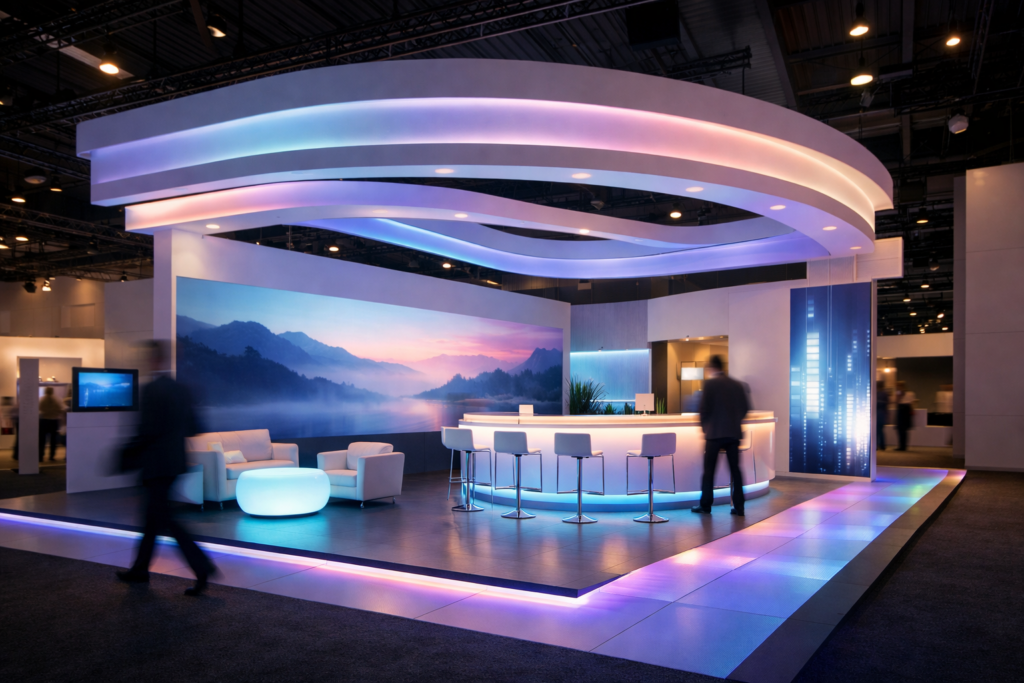
For a more versatile glow effect, programmable RGB lighting offers full color-changing capabilities. This is ideal for edge-lighting or creating a dynamic toe-kick that can match any color. When it comes to RGB lights, a little goes a long way. You don’t want a Clark Griswald holiday house (unless you do).
Layer Multiple Lighting Types
Many exhibit designers will mix multiple lighting types, like backlit fabric graphics, edge-lighting, and backlit logos. The key is to keep the lights in the same temperature zone. You don’t want a backlit graphic with a Cool White temperature (4000-6500K), which emits a blue tone, beside a plex logo with a Warm White temperature (2700-3000K), which has a yellow undertone.
Highlight Key Messages with Backlighting
Lights and motion attract attention, and a compelling message creates curiosity. Curiosity When an attendee is curious, they’re more likely to stop and then enter your booth space. Backlighting not only makes the message more visible, it also makes it easier to read, especially in exhibit halls with dim lighting.
Use Floor Lighting for Extra Impact
When it comes to flooring, most exhibitors choose a neutral carpet or rollable vinyl. And both are fine. But increasingly, many exhibitors view the floor as another valuable graphic space. The right flooring graphics adds to the overall theme of the booth space and more often than not elicits comments and compliments. Floor lighting adds an additional touch, and can be used to create paths, highlight products, or serve as an entrance or exit to the booth.
Add Motion-Based or Interactive Lighting
Motion-based and interactive lighting takes a trade show booth from a static display to an immersive experience. By using technology that reacts to attendee movement or touch, you transform visitors from passive observers into active participants, which can increase dwell time and brand recall. An example would be using Passive Infrared or Ultrasonic sensors. These sensors trigger specific lighting changes when someone walks into an area.
How to Choose the Right Lighting for Your Trade Show Booth
Match Lighting with Your Brand Identity
- Consider warm tones for lifestyle brands; cool tones for tech/modern brands.
- Maintain consistency across booth elements.
- For a booth that represents multiple brands, consider programmable RGB lights.
Think About Booth Size and Layout
- Small booths need brighter, tighter lighting. A little goes a long way in a smaller space.
- Larger booths need a variety of lighting options to avoid dark corners.
- For modular exhibits, consider how the lighting impacts the reconfiguration from an island to an inline booth.
Understand Venue Lighting Limitations
- All exhibits should have some display-specific lighting. Venue lighting isn’t intended to optimize either the design or the graphics of your booth.
- Venues still use a variety of lighting sources like halogen, fluorescent, and LED lights. Those lights all have different temperatures, which will dull or change your graphic colors.
Consider Power Requirements and Regulations
- Every show, every venue, and every GSC has their own rules and regulations regarding electrical installation, charges, and ordering requirements. Never assume the same rules apply from one show to another show.
- It pays to have a basic knowledge of your power requirements. Ordering too much can be costly and ordering too little can be catastrophic if your lighting fails during a show. Most show electrical service providers want you to get it right and are more than happy to assist you.
How Exhibits Northwest Helps Brands with Lighting
- Explain how they integrate lighting into custom-built exhibits.
- Mention lighting options available for modular and portable booths.
- Highlight the benefits of rental booths with included advanced lighting features.
Final Lighting Checklist Before Your Trade Show
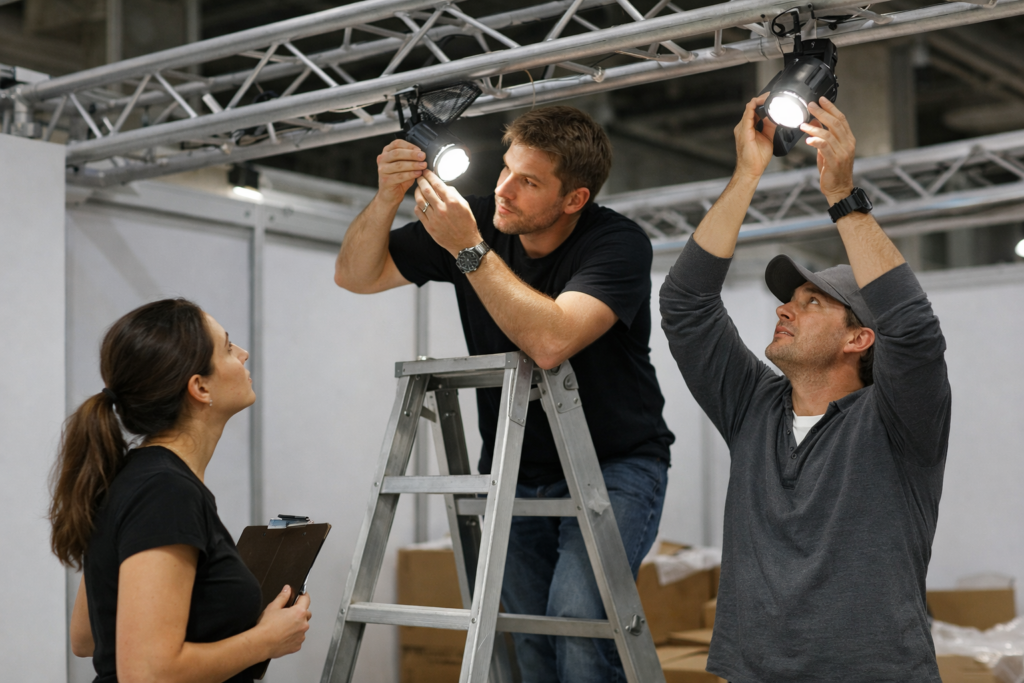
- Bring All Lighting Gear: Main lights, backlit panels, spotlights, floor/LED strips, and spare bulbs.
- Check Power & Cables: Confirm outlets, wattage limits, extension cords, surge protectors, and cable safety.
- Position Lights Strategically: Brighten booth entrance, highlight products, signage, and demo areas; avoid harsh shadows.
- Adjust Colors & Brightness: Match brand colors, ensure even lighting, avoid clashing warm/cool tones.
- Test for Camera & Visuals: Take photos/videos to check glare, reflections, and overall look.
- Final Function Check: Turn all lights on, check stability, flickers, or overheating.
- Prepare Backup: Extra lights, cords, and quick fixes for unexpected issues.
Conclusion
Smart trade show exhibit lighting improves booth appeal. That’s an undeniable fact. Lighting used to be an expensive upgrade and added complexity to design, build, and installation. That’s no longer true. LED lighting is cost-effective and durable and enhances the visual appeal of any booth, large or small.
At Exhibits Northwest, we know that lighting is simply one tool in a diverse design toolbox. Using that tool depends on understanding your marketing needs. We’ll always start with the assumption that your booth design will showcase your products and services while conforming to your distinctive marketing strategy. Every client is different. Every booth design is unique.
Our convenient location makes us the ideal choice for local companies exhibiting throughout North America and for exhibitors participating in a trade show in the Pacific Northwest. Experience the Exhibits Northwest difference today! Call or click for an appointment.
Frequently Asked Questions (FAQs)
How does lighting affect visitor engagement at trade shows?
Backlit graphics and logos will always be more vibrant and visible than non-backlit graphics and logos. On the trade show floor, every exhibitor is looking for an edge, and attracting attention is the first step to engagement.
Can portable lighting solutions work as well as built-in booth lights?
Whether you have a portable, modular, or custom booth, the lighting should be designed to optimize the presentation, assembly, and packaging. Does that mean that portable solutions are always comparable to a custom solution? No. But a backlit graphic on a portable display can be just as attractive and compelling as a backlit graphic on a modular or custom exhibit.
What are the most energy-efficient options for trade show exhibit lighting?
All LED lights are energy efficient, whether they’re arm lights, backlit light modules, or LED tape lights. While there are still some non-LED light options available, most exhibit houses default to the LED option if the performance is comparable. Consider the design impact first and foremost since the energy requirements will be minimal. The one exception to that is LED video tiles which while still energy efficient, require significantly more power than lights.
How early should I test my booth lighting before the show starts?
It’s never too early, whether you’re staging the exhibit at your facility or at the trade show. If there’s an issue with a light strip or a transformer, the electricians at the show will know how to fix it if they have the parts. You would be wise to bring a handful of replacement LED lights and transformers in your case or crate. Not only will it lessen your anxiety if anything goes wrong, but it will also save you money.