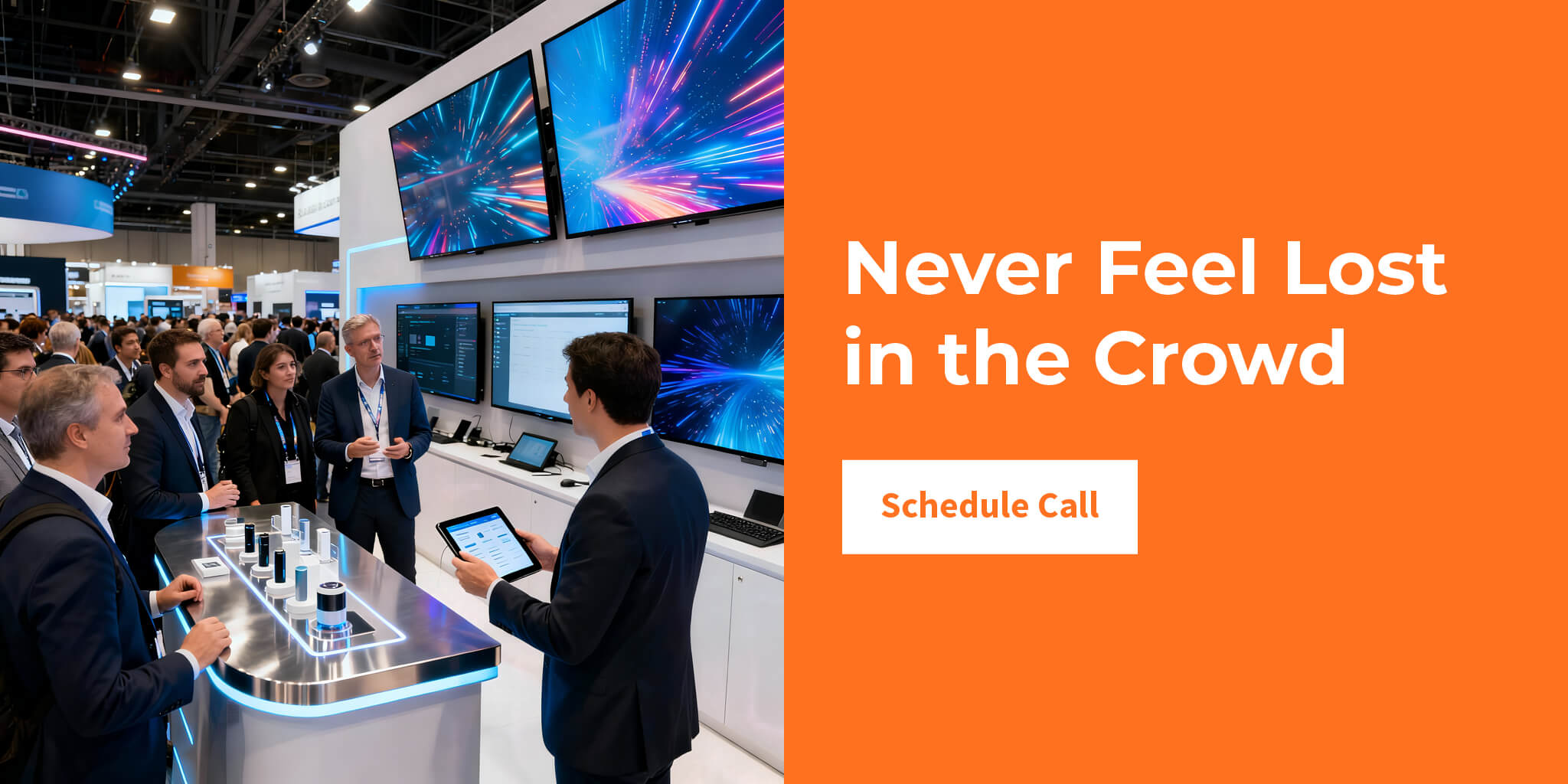


Every business needs at least one portable display stand. It doesn’t matter if your business has 20 or 200,000 employees and a marketing budget of $20K or $200 million. Your portable display could be a basic banner stand for your lobby, a pop-up display for the local Chamber of Commerce event, or a portable modular display for a regional trade show. Or all three.
Think of portable display stands as the “salt and pepper” seasoning for any trade show or event marketing program. They’re rarely the main ingredient but you’ll miss them if they’re not in your marketing mix.
Portable displays are lightweight, flexible, and easy to assemble, and the perfect choice when exhibitors need a low cost, low maintenance solution for a smaller event. Best of all, portable displays are available in a wide array of price points and designs ranging from inexpensive banner stands to reconfigurable portable modular systems. In this article, we’ll explore your portable display options and how to choose the right one for your marketing needs.
What Are Portable Display Stands for Exhibitions?
What does the “portable” in portable display mean? The short answer is a display that can be carried or wheeled into a facility and/or shipped via FedEx or UPS. So “portable” could be a carrying bag not much bigger than an umbrella or a 90 lb. roto-molded case with wheels.
Let’s make this easy to visualize. For example, the Pronto Retractable Banner Stand weighs about 12 lbs and ships in a lightweight padded shipping bag. On the other hand, the Symphony SYKN-2002 is a portable modular display that packs in (3) roto-molded cases with wheels with a total weight of approximately 270 lbs. Both are considered portable display stands. But, they are obviously very different and are meant for specific marketing purposes.
There are hundreds, if not thousands, of portable display stands. All available within a week or two. But before you head too far down the path of choosing and purchasing a portable display, remember that the Internet isn’t always your best friend. What’s pretty on a website can be pretty awful once you attempt to assemble it. Choose wisely grasshopper. Most portable display stands have warranties, but those warranties don’t typically include a return option or money back guarantee. It’s best to work with an exhibit professional who will ask you the right questions and ensure you order exactly what you need (vs. what seems like an incredible bargain).
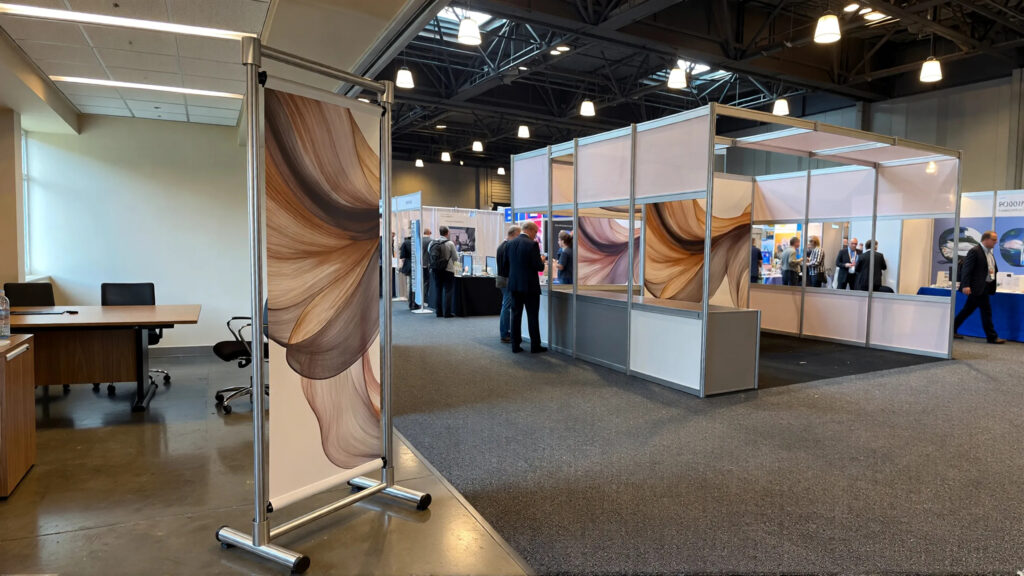
Why Portable Display Stands Are Becoming So Popular
The growing demand for portable and portable modular displays comes down to three reasons:
- Cost Savings: Traditional custom-built wood booths ship via LTL freight, incur costly material handling fees, and require onsite labor for installation and dismantle. All of which can cost thousands of dollars.
- Most portable display stands can be assembled in less than an hour without tools.
- Portable displays can be shipped via standard couriers (like FedEx or UPS).
- Purchasing a smaller, lighter exhibit for smaller shows equals a higher long-term ROI
- Versatility & Modular Design: Portable stands allow brands to pivot instantly with updated graphics and reconfigurable structures.
- Interchangeable graphics means you can keep the hardware but swap out the fabric or vinyl “skin” to match a new product launch or a different target audience.
- Modular systems allow you to use the same components to fill a small 10×10 booth or expand into a larger 20×20 space by linking frames together.
- Many companies use these portable stands in their office lobbies or for internal “town hall” meetings.
- Lightweight and Professional: Modern materials, like aluminum extrusion and dye-sublimated fabric graphics have elevated the over appearance of portable displays.
- High-resolution dye-sublimation printing on stretch fabric creates a seamless, wrinkle-free, and matte look that handles photography and video lighting perfectly.
- Modern stands are designed to hold tablets, LED backlighting (lightboxes), and even large monitors, bridging the gap between a simple banner and a high-tech digital experience.
A portable display solves three challenges faced by modern trade show exhibitors: cost, versatility, and upscale design. Not every exhibitor needs a custom exhibit. Modern portable displays allow companies to upgrade their trade show marketing game without a six figure investment.
Easy Setup Makes Trade Shows Stress-Free
Trade shows can be stressful and installation is often the most stressful task for exhibitors. Unlike custom exhibits, portable and portable modular displays are engineered systems, built with finite, connecting components. Once you’ve assembled a portable display the first time, it’s both repeatable and easier. There are no surprises. In addition, most portable displays require minimal tools for assembly (if any) and can be set-up in less than an hour.
Quick Assembly Without Special Tools
Many venues in North America require exhibitors to hire show labor if the assembly takes more than an hour or two and requires the use of tools. As a result, portable exhibits are engineered to assemble with minimal or no tools. Additionally, most can be set-up with one or two persons in less than an hour.
Perfect for Tight Setup Timelines
While larger trade shows have 2-3 days devoted to installation, smaller shows may only have 6 hours or even less to assemble their booth. Usually the evening or morning of the event. Those tight timelines are perfect for lightweight portables. The booth staff can arrive a few hours before the show and get the display and space ready in plenty of time .
Cost-Effective Solution for Businesses of All Sizes
Every small, medium, and large business has a portable display. Some have hundreds of pop-ups, banner stands, and portable modular inlines. Others have one or two. Portable trade show displays are a “force multiplier” for marketing budgets. These displays provide cost-effectiveness through three key financial levers: labor elimination, shipping reduction, and long-term reusability.
- Drastic Reduction in “Hidden” Costs: The price of a booth is more than just the hardware. Portable stands target the “hidden” expenses that often exceed the booth’s purchase price:
- Drayage (Material Handling): Most trade shows charge by weight to move crates from the dock to your booth. Portable stands pack into lightweight, wheeled cases that you can often wheel in yourself, bypassing hundreds or thousands in drayage fees.
- Professional Labor (I&D): Standard custom booths require “Installation & Dismantle” crews. A portable 10×10 tension fabric wall or pop-up can be assembled by one person in 10–20 minutes with zero tools.
- Electrical Fees: Newer portable systems often include battery-powered LED lighting or digital signage, eliminating the $150–$400 fee per show for electrical “drops.”
- Optimized Shipping Logistics: Because portable stands are designed to be compact, they move through the logistics chain differently than custom builds:
- Standard Couriers: Instead of hiring a freight trucking company, portable displays can be shipped via FedEx, UPS, or even checked as standard luggage on a flight.
- Weight Savings: Using aluminum frames and tension fabric can reduce shipping weight by up to 40-60% compared to traditional wood or heavy plastic panels.
- High ROI through Longevity and Flexibility: A portable display is a long-term asset, not a one-time expense.
- Interchangeable Graphics: You don’t need a new booth for every product launch. You simply buy a new fabric “skin” for a few hundred dollars while keeping the same frame.
- Multi-Use Deployment: When not at a show, these displays are light enough to be used in your office lobby, at a local chamber of commerce event, or even as a backdrop for corporate video calls.
- Modularity: Many systems, like Symphony Portable Displays, are “Lego-like.” You can use a single section for a small recruitment fair or link three sections together for a major industry conference.
Flexible Designs That Work for Any Booth Size
Not all portable systems are the same. Basic portables are lightweight, inexpensive, and attractive but lack the ability to grow as an exhibitor’s marketing needs evolve. Portable modular systems have two benefits: they are designed to be reconfigurable and offer a wider range of accessories like monitor mounts, shelving, locking counters, and iPad solutions. In addition, replacing graphics and obtaining replacement parts is generally easier with a portable modular display. Here are examples of a portable modular display.
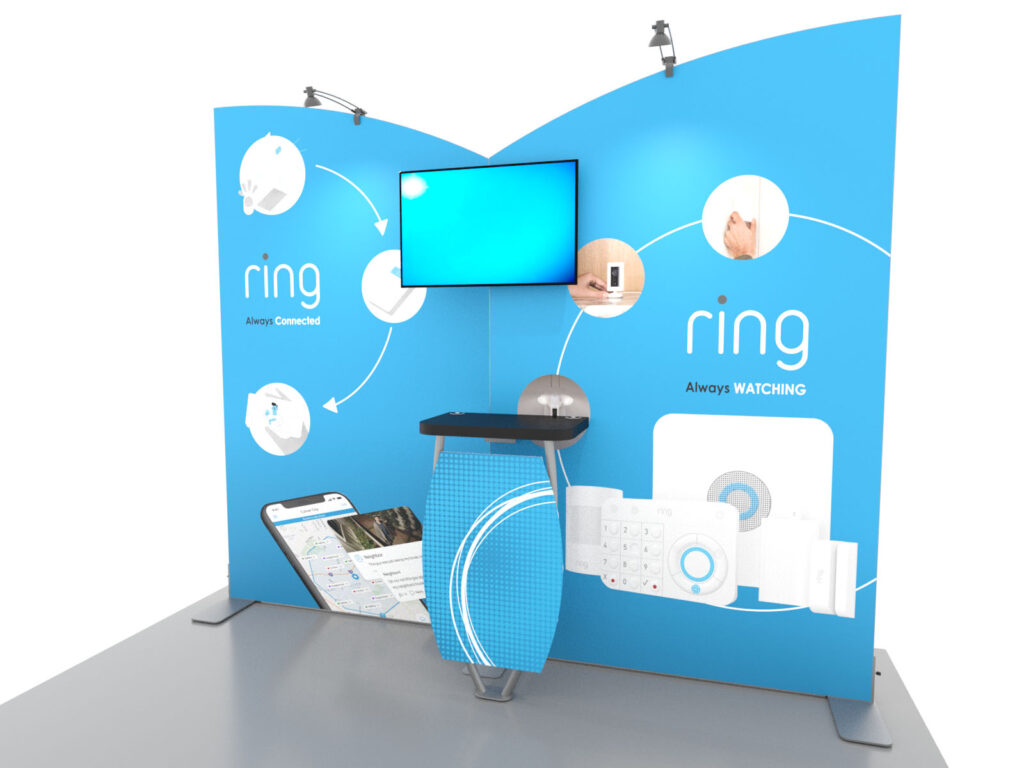
SYKN-1015 and SYKN-2009
The SYKN-1015 is a stylish 10 ft. display with SEG fabric graphics, monitor mount, backwall workstation, wireless charging, and LED stem lights. It assembles without tools and packs in (2) roto-molded cases with wheels.
The SYKN-2009 repurposes the curved backwalls and adds a concave aluminum frame to expand the display to a 10 x 20 booth space. In addition, there’s another backwall workstation, floating graphics, and a freestanding reception counter with locking storage. The concave frame can also be reconfigured as a standalone 10 ft. display.
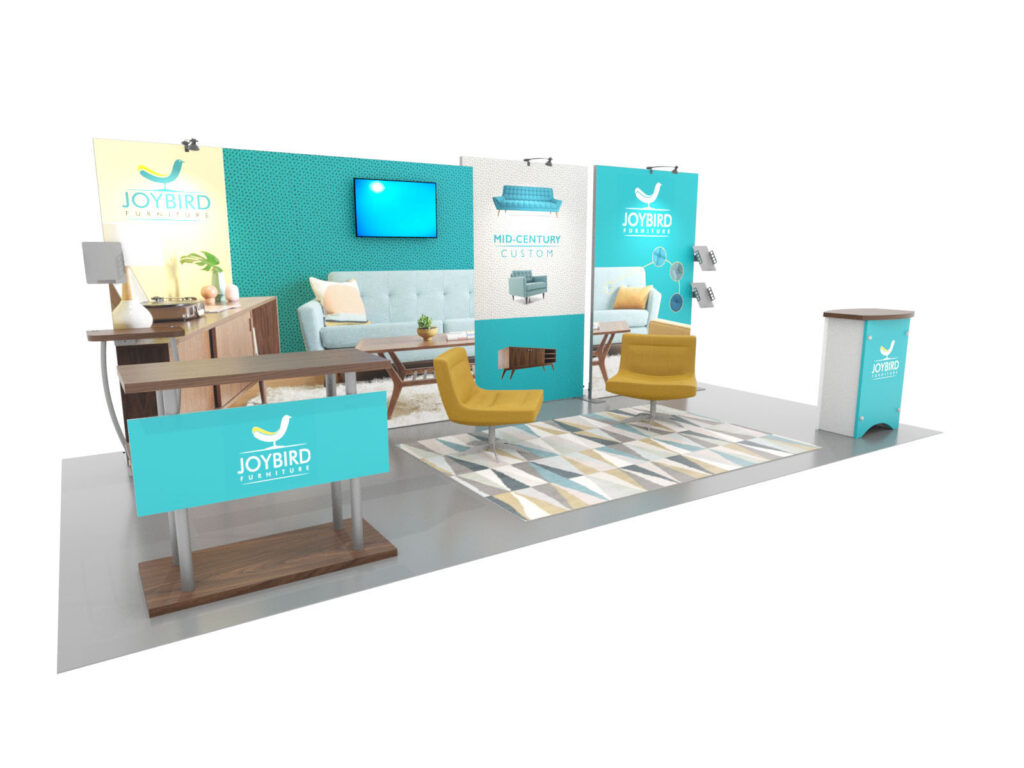
SYKN-1004 and SYKN-2004
The SYKN-1004 features two rectangle frames with SEG fabric graphics, , a workstation, SEG fabric graphics, a workstation with wireless charging, a reception counter, and (2) LED stem lights.
The SYKN-2004 uses those same rectangle frames but adds a large 8 ft. frame with SEG fabric graphics, (3) literature trays, monitor mount, and (2) freestanding counters. The 10 x 20 inline can easily be reconfigured into two 10 x 10 displays.
How Exhibits Northwest Helps with Portable Display Solutions
Choosing the right portable display can be a challenge. All too often, exhibitors spin the “portable wheel” online just hoping it will land on the right one. Don’t make that mistake. The professionals at Exhibits Northwest have spent the past 30 years separating the wheat from the chaff when it comes to portable displays. They know the vendors and the designs and will ensure you buy the perfect solution for your goals and your budget.
But success at trade shows is so much more than buying an exhibit. Exhibits Northwest will assist you with your trade show strategy, along with guiding you through a maze of logistics, material handling, and show preparation. We believe that knowing what to do (and what not to do) to be successful at a trade show shouldn’t be learned through trial and error or the school of hard knocks. Let us be your trade show guide. We’ve never lost anyone yet.
Explore your portable options in Exhibit Design Search, our comprehensive design database.