


You’re back from the annual industry trade show and the CEO asks., “Was the show a success?” To be honest, you have no clue. It seemed “good,” you met some potential new customers and increased your leads from the previous year. But measuring your trade show results wasn’t a goal. And to be honest, you’re not even sure what you should be measuring.
Clearly, that has to change, so when the CEO asks, “Why are you attending this show?” and “How did the show impact our pipeline, revenue, and brand?” you’ll be ready with both qualitative and quantitative data.
Most businesses struggle to measure their trade show success. They rely on vanity metrics (“Everyone liked our booth design.”) instead of setting clear pre-show, event, and post-show goals. But goals don’t matter if there isn’t a plan and the discipline to capture the targeted information.
In this article, we’ll explore various quantitative and qualitative metrics and how to set and measure your trade show results.
Why Measuring Trade Show Effectiveness Is So Important
Trade show marketing isn’t cheap. For some companies, it can represent as much as 30% of their annual marketing budget. For that reason alone, everyone should not only have a comprehensive trade show strategy but also a plan for measuring its effectiveness. Those measurements will guide your marketing decisions before, during, and after a show.
However, your measurement guidelines shouldn’t remain static or consistent. Just as your marketing objectives will change, so should you reevaluate what and how you want to measure the trade show data or outcomes.
Let’s start with some basic concepts. Trade show measurements are either quantitative or qualitative. In other words, think of ROI (Return on Investment) or ROO (Return on Objectives). Measurements don’t have to be based exclusively on numbers.
Perhaps one objective was soliciting feedback from customers on a new product. If we assume you had a strategy and plan for capturing that information AND did capture it, and then you shared it with the sales, marketing, and product development teams, then that would count as a measurement.
Start With Clear Trade Show Goals
Exhibitors are often uncertain what to measure. That’s understandable. It becomes even more challenging if there’s no clear trade show goals or strategy. Increasing sales is a worthy objective, but it’s not a strategy and without a method to measure “X” from a trade show, there’s no way to link your marketing at a trade show with an overall sales increase.
However, most exhibitors have multiple trade show goals like leads sales, brand awareness, new partnership, and client meetings. Some are easy to measure. Others are harder.
So what’s the difference between companies that succeed and those who fail at capturing the quantitative and qualitative data/information. It’s simple actually. They know what they want, they use tools (like lead retrieval software) to gather it, and they are ruthless about gathering and documenting it.
Planning and discipline matter. Many companies start with good intentions. They’ll say, “We’re going to book X meetings with clients before the show. Here’s what we want to learn or share. And then we’ll document it in our CRM software and share it with the appropriate people or departments.” But once at the show, it all falls apart. Nothing gets measured or is done haphazardly, which is even worse.
5 Examples of Trade Show Goals:
- Lead Generation (Quantity & Quality). Instead of focusing on “getting more leads,” your goal should be 100 leads who have scheduled a demo in the next month.
- Sales & Revenue. Sales from a show can be difficult to measure. Instead, measure signed contracts or show special orders of 10% off by a certain date.
- Brand Awareness. Encourage attendees to share your story in social media by giving them a product sample. Then compare your numbers from year to year or show to show.
- Customer Contacts. Host pre-scheduled meetings with top tier clients and then identify which ones purchase a featured product or service in the next six months.
- Market Research. Trade shows are a market research goldmine. Schedule your team to visit X number of competitor booths and gather information about pricing, new products, and overall traffic in their booth.
What Trade Show Metrics Actually Matter
This isn’t a trick question. All metrics matter, but some matter more depending on your goals. Because most exhibitors are not swimming in data after a trade show, any information can be valuable.
However, it’s critical to understand the difference between useful metrics and surface-level numbers. Savvy exhibitors have shifted away from “vanity metrics” (like the total number of badge scans) toward high-intent engagement data. 46% of attendees are now in senior management, so the focus is on quality of time spent rather than the quantity of people.
For Example:
- Qualified Engagement Time (QEM): Total badge scans don’t tell you much, but dwell time does.
- What it is: The average or total amount of time a qualified prospect spends in your booth.
- Why it matters: A 15-minute deep-dive demo is worth 50 “drive-by” badge scans for a free pen. High QEM correlates directly with a shorter sales cycle post-show.
- Cost Per Lead (CPL) vs. Cost Per Meeting: While CPL is a classic, the cost of securing a face-to-face meeting is becoming the gold standard.
- The Benchmarks: In 2026, the average trade show CPL is approximately $125.
- The “Meeting” Metric: It costs roughly $150 to meet a prospect at a trade show, compared to $350+ for a field sales call at their office. If your cost per on-site meeting is under $150, the show is a financial win.
- Lead Velocity (Sales Acceleration): Instead of just counting new leads, look at how the show impacted existing deals.
- The Metric: The percentage of existing pipeline opportunities that “moved a stage” (e.g., from Discovery to Proposal) because of a face-to-face interaction at the show.
- Why it matters: Trade shows are increasingly used to “unstick” stalled deals by providing a hands-on experience that digital calls can’t replicate.
- Navigation Friction Index: With modern heat-mapping and sensor technology, you can now measure how well your booth actually works.
- What it is: A score based on visitor flow. Does your layout cause “dead ends,” or do prospects flow naturally from the “hook” (hero product) to the “close” (private meeting area)?
- Why it matters: High friction leads to “bounce rates” where prospects leave before they are ever scanned.
- Content Activation & Share Rate: If you use QR codes for digital brochures or “lit-kits,” track how many people actually open them after leaving.
- The Metric: (Digital Downloads + Shares) / Total Scans.
- The Insight: If people scan your code but never open the file, your booth staff didn’t create enough “value gap” to make the content worth reading later.
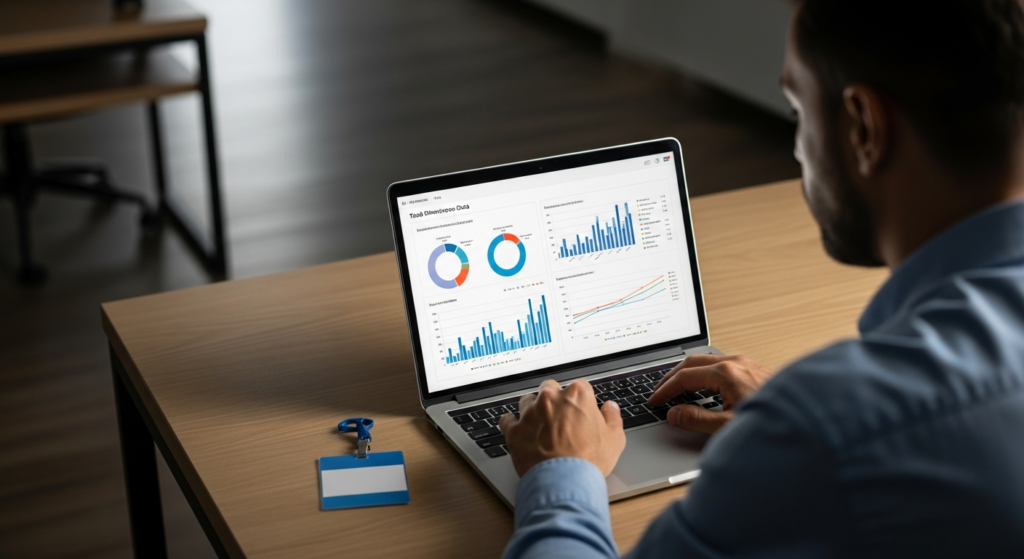
Trade Show ROI Measurement Methods
Measuring ROI can feel like a dark art, especially when sales cycles last for months. To get an accurate picture, look at both the immediate math and the long-term pipeline.
Here are four methods to measure your trade show ROI:
- The Simple “Net Profit” Formula: This is the most direct way to satisfy your CFO. It measures the immediate financial gain against the total cost of the booth, travel, and logistics.

- Use It: If you sell products directly on the floor or have a very short sales cycle (under 30 days).
- The Catch: This often ignores the value of long-term leads that haven’t closed yet.
- The Pipeline Attribution Method: For B2B companies with long sales cycles, you measure the potential revenue added to your CRM.
- The Calculation: Track every lead scanned and assign them a “Weighted Pipeline Value.” If a lead has a 20% chance of closing a $10,000 deal, they are worth $2,000 in pipeline ROI.
- Metric to Watch: Total Contract Value (TCV) generated vs. Show Spend. If you spent $20k to generate $200k in the pipeline, your “Pipeline ROI” is 10x.
- The “Cost-to-Meet” Comparison (Savings Method): Sometimes ROI is about money saved rather than money earned. This method compares the cost of meeting prospects at the show versus flying your sales team to meet them individually.
- The Math: * Average cost of a field sales visit: ~$250–$400 (flights, hotels, meals).
- Trade show cost per meeting: Total Show Cost ÷ Number of Quality Meetings.
- The Win: If you had 40 high-quality meetings at the show for a $10,000 investment, your cost per meeting was $250. You likely broke even on travel costs alone, making the leads “free.”
- The Digital Integration Method (Post-Show Attribution): Use unique tracking links or promo codes that are exclusive to the event.
- The Method: Provide a QR code that offers a “Show-Only” discount or a specific whitepaper. Use a UTM parameter (e.g., ?utm_source=tradeshow_2026) to track every action that lead takes on your website for the next 6 months.
- The Metric: Percentage of web traffic and conversions originating from the show-specific link.
To ensure your investment pays off, you must bridge the gap between the physical booth and your digital CRM. By setting SMART goals, tracking high-intent metrics (like dwell time), and applying a rigorous ROI calculation, you’ll transform a trade show from an “expense” into “revenue.”

Common Mistakes Businesses Make When Measuring Trade Show Success
Even with the best intentions, many exhibitors fall into “traps” that make their data look better—or worse—than it actually is. Or disqualify their data altogether.
Treating All Leads Equally.
Many exhibitors are obsessed with total scans at a show. In their quest for higher scans, they ignore qualifying the lead. A badge scan from a student looking for a free tote bag is not the same as a scan from a VP of Procurement. Success exhibitors segment leads by intent or authority and add copious notes so the sales team can follow up after the show.
Underestimating Costs.
Many exhibitors calculate ROI using only the booth space, cost of the exhibit, show services, and travel and entertainment costs, which leads to a false sense of profitability. They ignore staff time before, during, and after the show. Including the opportunity cost of the staff away from the office for 3-5 days.
Failing to Track “Lost” Opportunities.
You can’t measure what you didn’t capture. If your booth was so crowded that people walked away, or your staff was too busy talking to each other, you’ve lost potential ROI that won’t show up in any report. Assign one staffer to manage traffic or use sensor technology to see how many people entered your space versus how many were actually scanned.
The “Black Hole” of Follow-Up.
Success happens in the 72 hours following the event. Unfortunately, too many exhibitors wait more than a week to upload leads or send a generic “It was nice to meet you” email.
If you wait until you’ve “caught up” on emails back at the office, you’ve already lost. Instead, use a real-time lead capture app that syncs directly to your CRM. Aim for a 48-hour follow-up window with personalized notes referenced from the conversation.
Designing for Beauty Over Action.
Every exhibitor wants a stunning trade show exhibit. But a beautiful booth that doesn’t facilitate data collection is a failed investment. Attendees decide whether to stop in 3 to 5 seconds. If your booth is cluttered, they walk past, and you never get the chance to measure their interest. Design your graphics to explain what problem you solve, not what you do. Next, design the booth layout for traffic flow and ensure lead capture stations are at the perimeter so you can scan people without requiring them to fully enter a crowded space.
In the high-stakes environment trade shows, businesses that “win” treat them as a strategic data touchpoint rather than a standalone event. Success is no longer measured by the weight of the leads. The true ROI of a trade show often reveals itself 6 to 12 months after the curtains close. Consider maintaining an “Ongoing ROI” report to capture your long-tail wins.
How Exhibits Northwest Helps You Get Better Trade Show Results
Understanding your trade show goals is the first step toward creating a successful trade show strategy. At Exhibits Northwest, we have nearly 30 years of “listening” and “collaborating” with exhibitors.
Over the years, data gathering methods change, along with how to increase engagement with trade show attendees. You don’t want to guess. Identifying the right trade show partners for lead retrieval, gamification, staff training, and exhibit design matters much more than you may think. Exhibits Northwest has the experience to assist with fine tuning your strategy and the knowledge and tools to ensure you’re measuring what’s important to you.
Skip the “School of Hard Knocks” of trade show marketing. Trust the professionals at Exhibits Northwest.
Conclusion
Whether you’re new to trade show marketing or an accomplished trade show veteran, your ability to track, measure, and report your trade show ROI will determine not only your trade show marketing budget but also how to guide your trade show strategy toward successful results from show to show and year to year.
With over twenty years of experience designing, building, shipping, and storing trade show displays, the ENW team can assist you with the nuances and complexity of trade show marketing. And if you want your new exhibit to impress trade show attendees and draw crowds to your booth, then we’ve got that covered too. You can rely on their professional trade show management services.