


Perhaps no terms create more angst among trade show exhibitors and suppliers alike than drayage or material handling. And although the cost is rarely a surprise anymore, except to new or inexperienced exhibitors, the fee is nevertheless an annoying paper cut to most exhibitors. As an exhibitor in North American, drayable is unavoidable, but the cost can be predicted, managed and reduced.
In this post, we’ll define trade show drayage, explain what’s included, and how to plan and manage it. We can’t promise your bill from the General Service Contractor won’t include any surprise charges, but we can arm you with enough information to avoid the most common ones and how to dispute them if they’re unwarranted. Unreasonable is a different matter.
Key Takeaways
- Trade show drayage (or material handling) includes both the movement of freight within the exhibit hall, along with storage during the show.
- Knowing what drayage includes and how to calculate it may help you avoid unexpected drayage fees.
- Why shipping to the Advance Warehouse, even if it’s slightly more expensive, can save you money in the long run.
- How exhibit design, materials, and packaging are the keys to reducing your drayage costs.
- Why renting your exhibit may be a smarter alternative for specific trade shows.
What Is Trade Show Drayage?
If you’re confused about the difference between trade show drayage fees and standard freight charges, you are not alone. In short, it’s about location, location, location. Standard freight gets your materials to the venue’s loading dock. Drayage covers the logistics required to move those materials from the dock to your specific booth space. Sometimes the logistics are straightforward; from dock to booth space. But not always. Drayage or material handling can include transportation from an advanced warehouse, storage of the cases/crates during the show, and moving cases/crates to and from the booth space after the show.
While a freight carrier handles shipping to the venue, the General Show Contractor (GSC) is responsible for the movement and storage of freight throughout the show process. The show organizer hires the GSC to handle this and other activities and, in most cases, the GSC charges the exhibitor for those services.
Drayage vs. Freight: What’s the Difference?
| Expense | What It Covers | Typically Controlled By |
|---|---|---|
| Freight/shipping | Transportation to or from the event | Freight carrier |
| Drayage/material handling | Moving freight between receiving area and booth | Show contractor/venue |
| Installation | Assembly of the exhibit | I&D labor/provider |
| Storage | Holding freight or exhibit materials | Warehouse/storage provider |
For new exhibitors, the distinction between the freight carrier, the GSC, and the organizer can appear opaque. Yet, all have different roles and responsibilities. Paying a freight carrier to transport an exhibit to the convention center rarely covers show-site material handling.
What Does Trade Show Drayage Include?
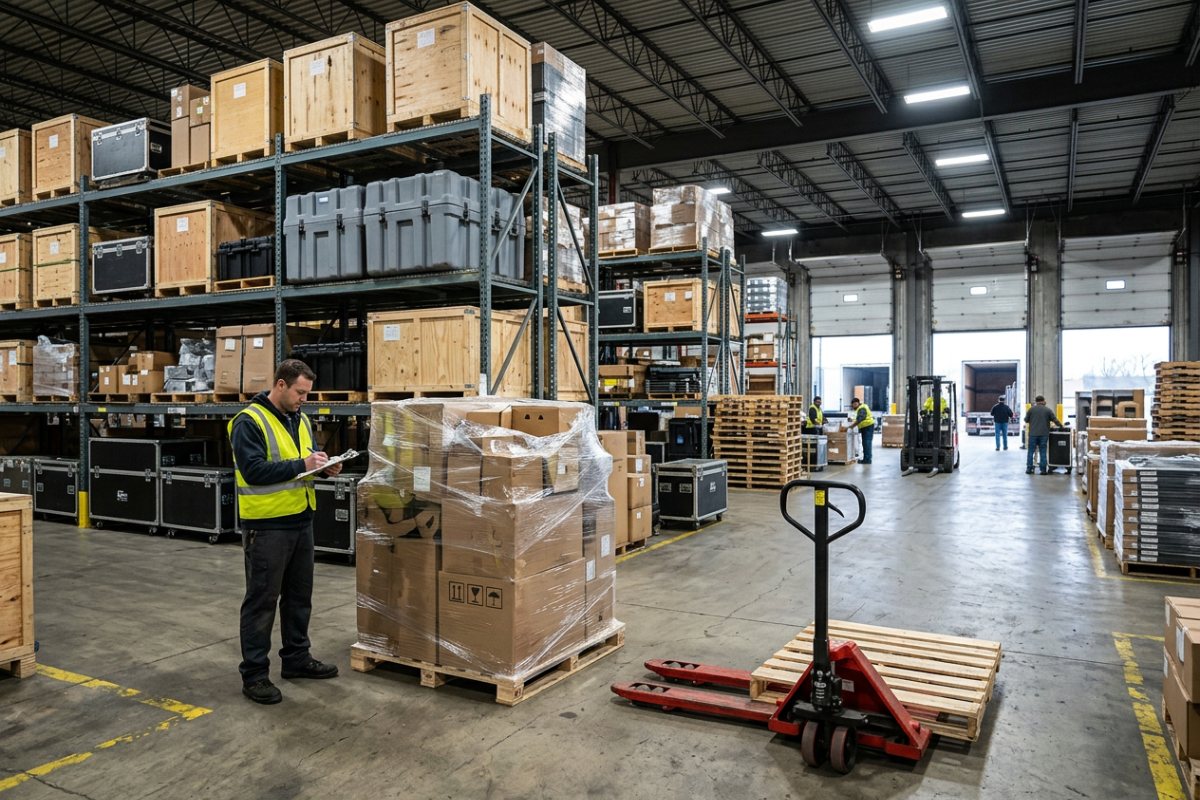
Trade show material handling covers more than you think and, thankfully, the charges are more transparent than ever before. Pre-covid, drayage charges were CWT, which stands for hundredweight, a traditional unit of weight used in shipping, logistics, and commodity trading. The abbreviation combines the Roman numeral C (meaning centum, or 100) with wt for weight. No one except freight carries “think’ in CWT so the final charge was more often than not a surprise. Today, GSCs charge per lb., like $2.75 per lb. (as an example). Which is much more straightforward if not any less expensive.
To be fair, trade show drayage is more than just dropping a crate at your booth. The table below lists the six most common activities.
| Drayage Activity | What Happens |
|---|---|
| Receiving | Freight is accepted at the warehouse or show site |
| Unloading | Shipment is removed from the carrier |
| Transportation | Freight is moved to the exhibitor’s booth |
| Empty container storage | Crates/cases may be moved to storage |
| Return handling | Empty containers are returned for teardown |
| Outbound movement | Exhibit freight is moved back to the loading area |
How Much Does Trade Show Drayage Cost?
In an ideal world, trade show material handling would be the same in San Antonio and Chicago, Or even the same at one show at the Orange County Convention Center in Orlando and a different show two weeks later in Orlando. But it’s not. Labor rates vary by region and GSC contracts with show organizers are just as variable. Contract services vary and GSCs will often set their rates based on what services they manage, the size of the show, and any margin opportunities or constraints.
Unfortunately, you can’t control the weight per lb., although if you feel it’s excessive then you should discuss it with the show organizer (not the GSC). If enough exhibitors grumble, then the show organizer will be more likely to negotiate a lower rate with the GSC at the next trade show.
Your specific charges are calculated on weight, shipment type, delivery timing, special handling, and other event-specific factors.
What Factors Affect Drayage Costs?
These variables can increase the final bill:
- Shipment weight and dimensions — heavier or larger freight generally creates greater handling requirements.
- Number of pieces — multiple crates, pallets, or loose pieces can complicate handling.
- Delivery timing — advance warehouse and show-site deadlines may have different rates.
- Special handling — unusual dimensions, mixed materials, loose pieces, or difficult-to-handle freight can affect costs.
- Late delivery — missing advance or targeted delivery windows can result in higher charges.
Advance Warehouse vs. Direct-to-Show Delivery
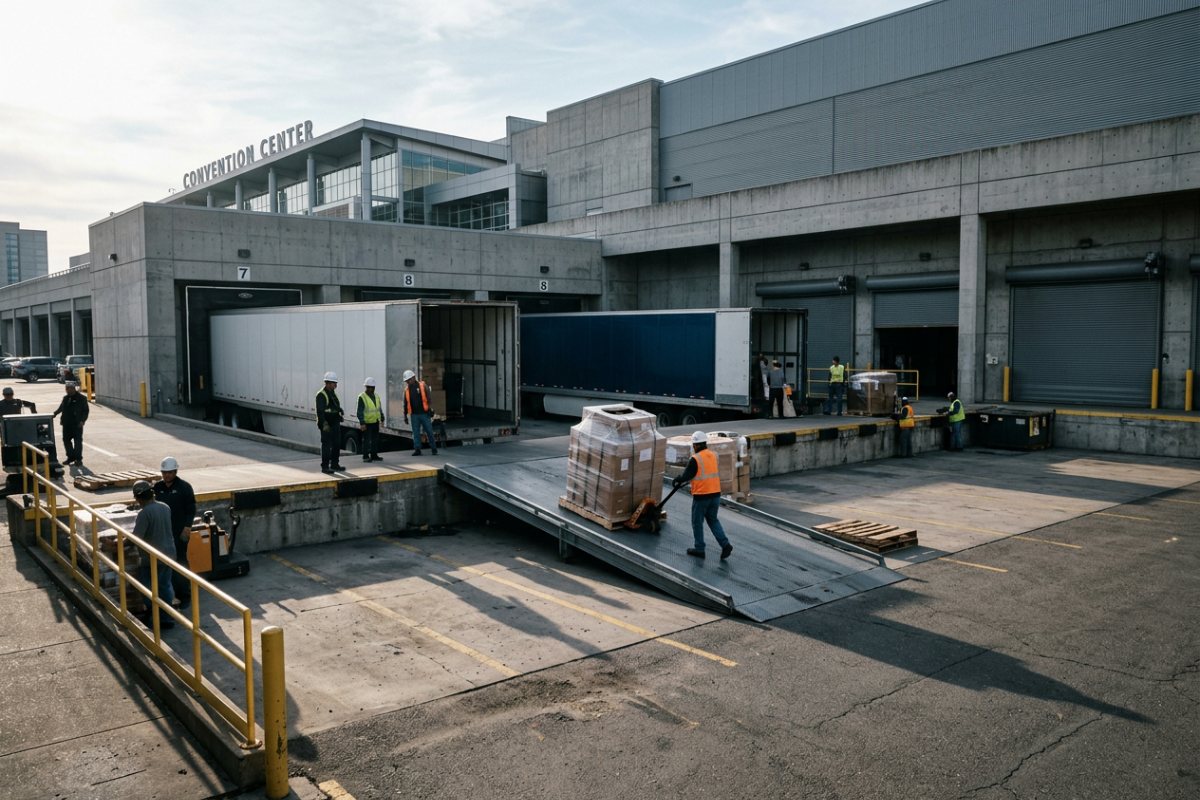
Freight shipped to the show’s advance warehouse can carry a higher drayage rate than freight shipped direct-to-site, but it guarantees your materials are waiting in your booth when move-in begins and avoids driver wait-time surcharges at busy docks. However, the advance rate isn’t automatically higher. Many GSCs would rather receive freight at the advance warehouse since it makes the move-in process more predictable. They can move your freight to your booth space earlier, which avoids congestion on the dock and the crate chaos on the show floor.
For exhibitors, the advance warehouse has two disadvantages and multiple advantages. The charges may be higher and the freight shipped earlier. Sometimes as much as a month before the show. However, an earlier shipment means greater flexibility and some timeless better freight rates. In addition, there are rarely “wait time’ charges which can happen when trucks are lined up right before a trade show jockeying for dock space. In addition, when your booth arrives early, it also means you can schedule labor with some degree of predictability. A direct-to-show delivery means scheduling labor is often a guessing game.
| Factor | Advance Warehouse | Direct-to-Show |
|---|---|---|
| Delivery deadline | Earlier | Later/closer to show |
| Flexibility | More buffer before move-in | More time-sensitive |
| Storage | Held before show | Usually arrives during move-in |
| Risk | Less dependent on show-day delivery | Greater timing sensitivity |
| Best suited for | Complex logistics or early shipments | Well-coordinated, time-sensitive freight |
Why Do Trade Show Drayage Bills Get So Expensive?
Here’s what no GSC or show organizer is ever going to tell you. Drayage is essentially a miniature, highly compressed logistics operation that subsidizes the entire physical management of the hall. It’s the slush fund that pays for more than freight and storage. It’s expensive, but small decisions—such as shipping multiple small packages instead of one consolidated shipment—can increase handling complexity. In addition, late deliveries, special handling, overtime situations, or incorrect paperwork can compound costs.
You can control some of these with planning and knowledge. Always treat material handling as a planned line item in your trade show budget rather than an unavoidable surprise. You can’t control the union labor rates or the venue infrastructure costs. But you can control special handling fees and the overall weight of your exhibit.
Common Drayage Cost Traps
| Cost Trap | Why It Happens | Better Approach |
|---|---|---|
| Ignoring advance deadlines | Shipment misses preferred receiving window | Track all show deadlines |
| Multiple loose shipments | More pieces require handling | Consolidate when practical |
| Poor packaging | Freight requires special handling | Use appropriate exhibit packaging |
| Late freight | Missed target/receiving window | Build transportation buffer |
| No pre-show budget | Drayage comes as a surprise | Review rates before shipping |
8 Ways to Reduce Trade Show Drayage Costs
To lower trade show drayage expenses, focus on consolidating freight, smart scheduling, lightweight booth design, and utilizing allowed self-handling options.
1. Ship Early and Meet the Advance Deadline
- Review the event’s official receiving deadlines and determine whether advance warehouse delivery makes financial and logistical sense.
- Build contingency time into the transportation schedule instead of targeting the final acceptable delivery window.
2. Consolidate Your Exhibit Shipment
- Combine exhibit components into fewer manageable shipments. This will simplify receiving and handling.
- Coordinate exhibit graphics, hardware, furniture, and accessories where practical rather than sending separate shipments from multiple vendors.
3. Use Proper Exhibit Packaging
- Reusable crates and protective cases can reduce damage risk and make recurring transportation more organized.
- Connect packaging design with the exhibit’s long-term shipping requirements.
4. Review the Exhibitor Service Manual
- Identify the material-handling section before the event and note deadlines, rates, minimum charges, special handling rules, and receiving instructions.
- Highlight discounted advance-order deadlines where applicable.
5. Avoid Unnecessary Special Handling
- Understand whether your freight contains loose pieces, unusual dimensions, mixed materials, or other characteristics that could trigger special handling.
- Coordinate your packaging with your exhibit provider before final shipment.
6. Keep Accurate Freight Documentation
- Confirm shipment weight, dimensions, piece count, carrier information, and destination before pickup.
- Keep bills of lading, tracking information, and receiving documentation organized.
7. Consider Exhibit Design and Shipping Requirements Together
- Custom modular, modular, and portable exhibit construction can affect the number, size, and weight of shipping containers.
- Discuss material handling, transportation, and I&D with the designer during the design phase—not after production.
8. Work With an Experienced Trade Show Partner
- Rely on your exhibit partner for advice and guidance. Their experience will ensure you maximize not only your trade show marketing results but minimize your overall costs.
- The Exhibits Northwest professionals have seen the good, the bad, and the ugly regarding trade show planning and poor decisions by clients. Tap into their school of hard knocks knowledge.
How Exhibit Design Can Affect Drayage Costs
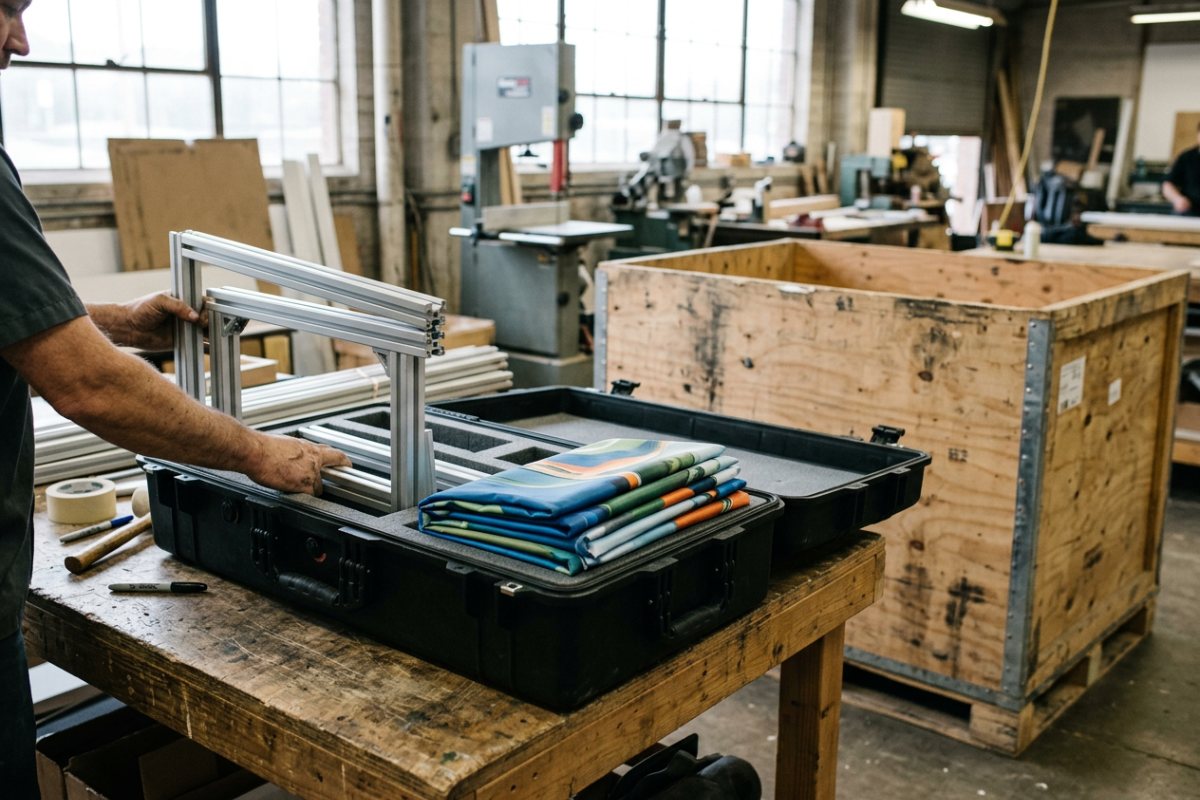
Exhibit design directly determines your drayage bill because material handling costs are driven entirely by three factors: gross weight, crate volume/configuration, and handling complexity.
Decisions made at the drawing board long before the show floor can either balloon your drayage costs or keep them manageable.
1. Choice of Structural Materials (Weight)
Drayage is billed by weight. The core materials you select for walls, bulkheads, and overhead elements are the single biggest weight drivers:
- Traditional Custom Wood & Laminate: Dense particleboard, plywood, and high-pressure laminate structures look substantial, but they are extremely heavy. Heavy wall panels rack up CWT rapidly.
- Aluminum Extrusions & Modular Systems: Replacing solid wood framing with lightweight structural aluminum extrusions gives the same visual footprint at a fraction of the structural mass.
- Tension Fabric Graphics vs. Rigid Infill Panels: Large-format dye-sublimated fabric graphics pack down into small bags and weigh pounds instead of hundreds of pounds. Replacing rigid direct-print acrylic or Sintra wall panels with stretched fabric drastically slashes billable weight.
2. Packaging, Container, & Crate Engineering
Drayage billing includes the weight of the shipping container itself, along with how easily a forklift operator can move it.
- Heavy Wood Crates vs. Rotomolded Cases: A 3/4-inch plywood crate with steel corners can weigh 400 to 800 lbs empty before you put a single component inside. Engineered composite or roto-molded polyethylene cases provide durable protection while keeping tare weight minimal.
- Master Crating vs. Multiple Individual Cases: If you ship 6 small individual cases, each under 100 lbs, on separate Bills of Lading, the general contractor may charge a 200 lb minimum per piece (effectively billing you for 1,200 lbs). Designing display components to nest into a single master crate or skid-mounted container ensures you are billed for actual weight rather than multiple minimum penalties.
3. Avoiding “Special Handling” Surcharges Through Packaging Design.
General Service Contractors apply surcharges (typically a 25% to 50% markup) for freight that requires extra labor or non-standard equipment to unload:
Can Exhibit Rentals Help Reduce Logistics Costs?
Exhibit rentals have gone from an occasional option to a default choice for many exhibitors. However, a rental doesn’t automatically reduce material handling or logistics costs. For exhibitors attending occasional events, testing new markets, or using a smaller display, a lightweight rental can reduce freight, drayage, and storage costs. Most rentals are modular systems which pack efficiently in cases or crates meaning fewer containers. Rentals don’t eliminate drayage, but they can reduce the overall cost of ownership.
For example, you may own a custom modular exhibit that reconfigures from an island into an inline. If the exhibit is designed well and the packaging engineered efficiently, switching from an island to an inline may be easy. However, that’s not always the case and the inline may require the same number of crates as the island because of inefficient packaging. A rental may be a better choice since it will fit in fewer crates saving on both shipping and drayage charges.
Trade Show Drayage Checklist
| When | Drayage Task |
|---|---|
| 8–12 weeks before | Review exhibit requirements and event logistics |
| 4–8 weeks before | Review service manual and shipping options |
| 2–4 weeks before | Confirm shipment weight, dimensions, and piece count |
| Before shipping | Verify receiving address and deadlines |
| Before pickup | Confirm carrier, paperwork, labels, and tracking |
| Before move-in | Confirm freight has been received |
| During installation | Verify all exhibit components arrived |
| After the show | Confirm outbound freight and carrier pickup |
| After return | Inspect freight and document damage |
How an Experienced Exhibit Partner Can Help With Drayage
An experienced professional exhibit partner can coordinate storage, staging, shipping, installation, show-site logistics, dismantling, repairs, and inventory, reducing the number of moving parts the exhibitor must personally manage. Exhibits Northwest specifically offers these types of management services. You can’t eliminate drayage—but you can plan for it, understand it, and prevent avoidable charges.
Exhibits Northwest’s nearly three decades of experience and thousands of projects is just one reason to choose them. ENW offers several multiple advantages, particularly if you value custom design capability, local production control, and long-term asset management. Rather than juggling multiple vendors for graphic production, freight, and show services, ENW handles the entire lifecycle of an exhibit program.
Conclusion
Drayage may seem like a minor detail in trade show logistics, but its impact on an event budget can be substantial. Understanding the factors that drive material handling costs – from weight calculations and minimum billing tiers to handling surcharges – gives exhibitors the insight needed to manage these expenses strategically. Through thoughtful choices in exhibit architecture, smart packaging, proactive logistics management and your exhibit partner, trade show teams can keep drayage fees from eroding their overall event ROI.
Having a local, full-service partner in the Pacific Northwest simplifies logistics. At Exhibits NW, we’ve been assisting clients to formulate and implement their trade show strategy for 30+ years. We understand trade show marketing. More importantly, we are committed to helping our clients chart a path to trade show success show after show, and year after year. Whether you’re looking for a custom, modular, or portable display, or just a trusted partner to ensure your success, contact the Exhibits NW creative team so we can ensure you exceed your trade show goals!
FAQs
Is trade show drayage the same as shipping?
There’s shipping to the trade show venue and shipping within the venue. Drayage is the latter. It covers transportation from the convention center dock to the booth space and then storage during the event.
Does trade show drayage include installation?
Drayage does not include installation and dismantle. I&D is handle by show labor or labor provide by an exhibitor-appointed contractor. See www.eaca.com for details about exhibitor-appointed contractors.
Can I avoid trade show drayage fees entirely?
It depends on the venue, but in general, if you’re able to carry your exhibit into the exhibit hall and assemble it, typically within an hour or less. This would include banner stands, pop-up displays, and some tube displays with pillowcase graphics.
Are drayage fees based only on the weight of my exhibit?
Weight is the primary factor but not the only one. Exhibits that require additional handling, like pallets with loose items or stacked crates may incur special handling fees. Contact the General Show Contractor if you have questions about your shipment.
Who should I contact if my drayage charges seem incorrect?
Always start with the General Show Contractor. Mistakes happen and they want to resolve them just as much as you do. If you feel the GSC isn’t responsive or reasonable, then contact show management. Show management hired the GSC and may be able to assist you want any disputes. You may also want to contact The Exhibitor Advocate, a non-profit dedicated to supporting the exhibitor community (https://www.exhibitoradvocacy.com/).